
Product
SHS Ceramic Composite Pipes
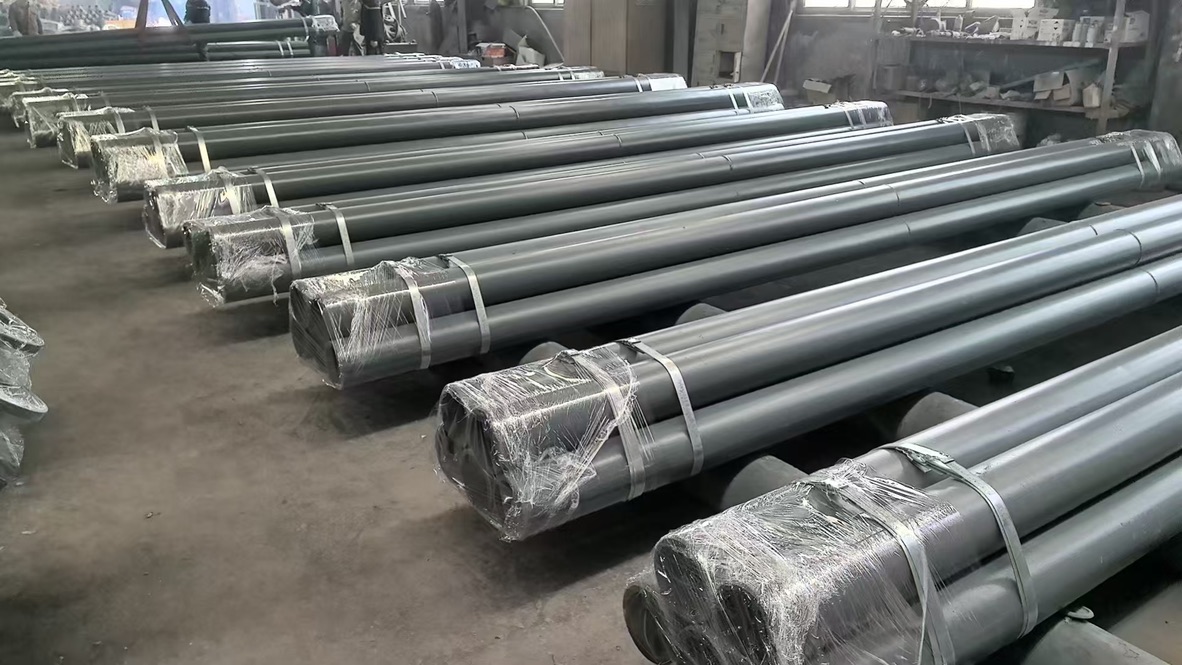
A corundum ceramic layer formed by self-propagating high-temperature synthesis and joined to the steel pipe through a transition layer.


Overview
SHS ceramic composite pipes are produced by self-propagating high-temperature synthesis (SHS) combined with centrifugal technology. The finished wall is a three-layer build-up: a corundum ceramic layer on the bore, a transition layer, and the steel pipe that carries the structural load. The composite combines the strength and toughness of steel with the wear, corrosion and heat resistance of ceramic, and the pipe can be cut and welded.
The ceramic layer gives the bore its hardness and its resistance to chemical attack, while the transition layer joins it to the steel. The pipe is therefore aimed at fine, highly abrasive media, including duties where the medium is also corrosive.
SHS ceramic composite pipes are not the same product as alumina ceramic tile or ring linings. An SHS pipe forms its ceramic layer and transition layer in place inside the pipe wall; a tile or ring lining is made of separate ceramic pieces bonded and anchored into a steel shell.
High wear resistance
The corundum ceramic layer reaches a Mohs hardness of up to 9.0.
Impact resistance and weldability
Impact resistance is higher than that of ceramic tile and ceramic ring linings: the corundum layer is formed in place and joined to the steel through a transition layer, rather than being made up of separate pieces bonded into a shell. The pipe is also weldable — confirm the welding procedure for your pipe and joint with our engineers.
Corrosion and scale resistance
The ceramic layer resists acids, alkalis, seawater and scaling.
Low flow resistance
A smooth inner surface keeps flow resistance low.
Relatively light, easy to install
A comparatively light pipe, durable and straightforward to install.
Heat resistance
The ceramic layer is stable at high temperatures; its melting point is about 2100 °C.
Structure & shapes
Self-propagating high-temperature synthesis (SHS) combined with centrifugal technology forms the ceramic layer and the transition layer inside the steel pipe. The finished wall is a three-layer composite: a corundum ceramic layer, a transition layer and the steel pipe.
Material: Corundum ceramic layer and transition layer in a steel pipe
Available shapes
- Straight pipe
- Elbow
- Tee
Specifications
| Specification | Value |
|---|---|
| Ceramic layer hardness | 1100–1400 HV (kg/mm²) |
| Compressive strength | 300–650 MPa |
| Inner surface | Smooth |
| Interlayer bond strength (compressive shear) | 15–30 MPa |
| Mechanical impact resistance | 15 cycles — 5 J point contact on the pipe body, counted until the ceramic layer cracks |
| Thermal shock resistance | 1000 °C — the temperature at which the ceramic layer cracks after three heat-quench cycles |
Working conditions
These are the duties this product is built for. Final selection depends on the measured conditions at your site — send them and our engineers will review the application rather than apply a single material rule.
- High abrasion at low impact; direct impact on the ceramic layer should be controlled
- Fine powders and slurries
- Media that are also chemically aggressive; the ceramic layer resists acids, alkalis, seawater and scaling
Applications
Mining & Mineral Processing
Mining and mineral processing convey highly abrasive slurries and solids — mineral slurries, tailings, concentrates and backfill. Wear concentrates where flow changes direction and where solids travel at speed, so pipe, elbow and tee selection must follow the actual operating conditions rather than a single material rule.
Typical media: Mineral fines, tailings slurry, and coal slurry.
Cement, Ceramics & Building Materials
Cement, ceramics and building-material handling moves both dry powders and granules and wet media — cement, clinker, slag and limestone powder on one side, and gypsum slurry, ceramic slurry and ceramic mortar on the other. The two states wear pipework differently and must be evaluated separately.
Typical media: Cement, lime powder, gypsum slurry, and ceramic slurry.
Power & Coal
Power and coal handling moves both dry media — pulverized coal and fly ash — and wet media such as ash slurry and coal slurry. Dry and wet conveying impose different wear and corrosion conditions, so each stream is evaluated on its own terms.
Typical media: Pulverized coal, fly ash, and ash slurry.
Steel & Metallurgy
Steel and metallurgy handling moves coarse, hard and highly abrasive solids — ore fines, coke fines, sinter, slag and metallurgical dust. Wear is driven by particle hardness and shape as much as by velocity, so liner selection follows the measured duty rather than a single material rule.
Typical media: Slag fines, process dust, and abrasive slurries.
Chemical Industry
Chemical and process duties combine abrasion with corrosion — slurries, process dust and abrasive media that attack the pipe wall chemically as well as mechanically. Suitability depends on the chemical properties of the conveyed medium and on product purity requirements, not on wear resistance alone.
Downloads
Request a quote for SHS ceramic composite pipes
Tell us the medium, particle size, velocity, pressure and the dimensions you need — unknown values may be left open for our engineering review.
Drawings can be sent to info@wearresistantpipes.com.