
Product
Induction-Hardened Pipes
Pipes whose inner surface is hardened by induction, giving a hard bore inside a tough steel body.
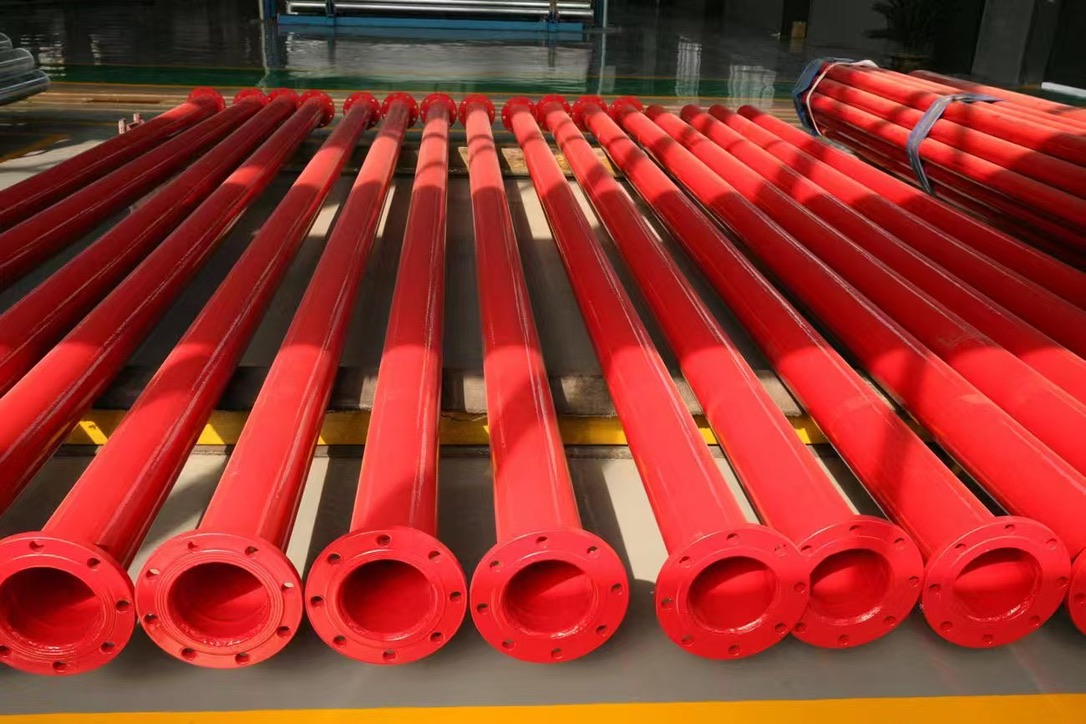

Overview
Induction-hardened pipes are made by hardening the inner surface of a base pipe by induction. The result is a pipe that is hard inside and tough outside: the bore carries the wear resistance while the outer wall keeps the toughness of the base material.
The base material can be high-chromium cast iron, 16Mn or 55Mn steel, or a bimetal pipe. Achievable values depend on the base material, the pipe dimensions and the heat-treatment parameters, which is why the hardness is given as a range rather than a single figure.
Hard inside, tough outside
The hardened bore provides the wear resistance while the outer wall keeps the toughness of the base material.
Adjustable hardened layer
The wear layer thickness is adjustable between 2 mm and 20 mm.
Several base materials
High-chromium cast iron, 16Mn, 55Mn steels and bimetal pipes can all be used as the base pipe.
Cutting and welding
Suitable for cutting and welding without damaging the wear layer. The method has to suit the pipe and the joint, so confirm it with our engineers before fabrication.
Process
Base pipe
The pipe starts from a base material: high-chromium cast iron, 16Mn, 55Mn steel or a bimetal pipe.
Induction heating
The inner surface of the base pipe is heated by induction.
Quenching
The heated inner surface is quenched, which hardens the bore of the pipe.
Hardened inner wall
The finished pipe has a hardened wear layer 2–20 mm thick, with an inner-wall hardness of 50–70 HRC depending on the base material, the pipe dimensions and the heat-treatment parameters.
Structure & shapes
Only the inner surface is hardened, so the wear layer is the hardened bore while the outer wall stays the tough base material. The wear layer thickness is 2–20 mm and is adjustable.
Material: Base pipe in high-chromium cast iron, 16Mn or 55Mn steel, or bimetal pipe, with an induction-hardened inner wall
Specifications
| Specification | Value |
|---|---|
| Inner-wall hardness | 50–70 HRC (depending on base material, pipe dimensions and heat-treatment parameters) |
| Hardened wear layer thickness | 2–20 mm (adjustable) |
| Long-term service temperature | Below 300 °C |
| Base materials | High-chromium cast iron, 16Mn, 55Mn steels, bimetal pipes |
Working conditions
These are the duties this product is built for. Final selection depends on the measured conditions at your site — send them and our engineers will review the application rather than apply a single material rule.
- High abrasion with controlled impact
- Fine and coarse solids
- Slurry and backfill duties
- Where the base material suits the duty and a hardened bore is required
Applications
Mining & Mineral Processing
Mining and mineral processing convey highly abrasive slurries and solids — mineral slurries, tailings, concentrates and backfill. Wear concentrates where flow changes direction and where solids travel at speed, so pipe, elbow and tee selection must follow the actual operating conditions rather than a single material rule.
Cement, Ceramics & Building Materials
Cement, ceramics and building-material handling moves both dry powders and granules and wet media — cement, clinker, slag and limestone powder on one side, and gypsum slurry, ceramic slurry and ceramic mortar on the other. The two states wear pipework differently and must be evaluated separately.
Power & Coal
Power and coal handling moves both dry media — pulverized coal and fly ash — and wet media such as ash slurry and coal slurry. Dry and wet conveying impose different wear and corrosion conditions, so each stream is evaluated on its own terms.
Steel & Metallurgy
Steel and metallurgy handling moves coarse, hard and highly abrasive solids — ore fines, coke fines, sinter, slag and metallurgical dust. Wear is driven by particle hardness and shape as much as by velocity, so liner selection follows the measured duty rather than a single material rule.
Downloads
Request a quote for induction-hardened pipes
Tell us the medium, particle size, velocity, pressure and the dimensions you need — unknown values may be left open for our engineering review.
Drawings can be sent to info@wearresistantpipes.com.