
Product
16Mn Steel Pipes
Low-alloy high-strength structural steel pipes: the unhardened steel baseline of the wear-resistant range.
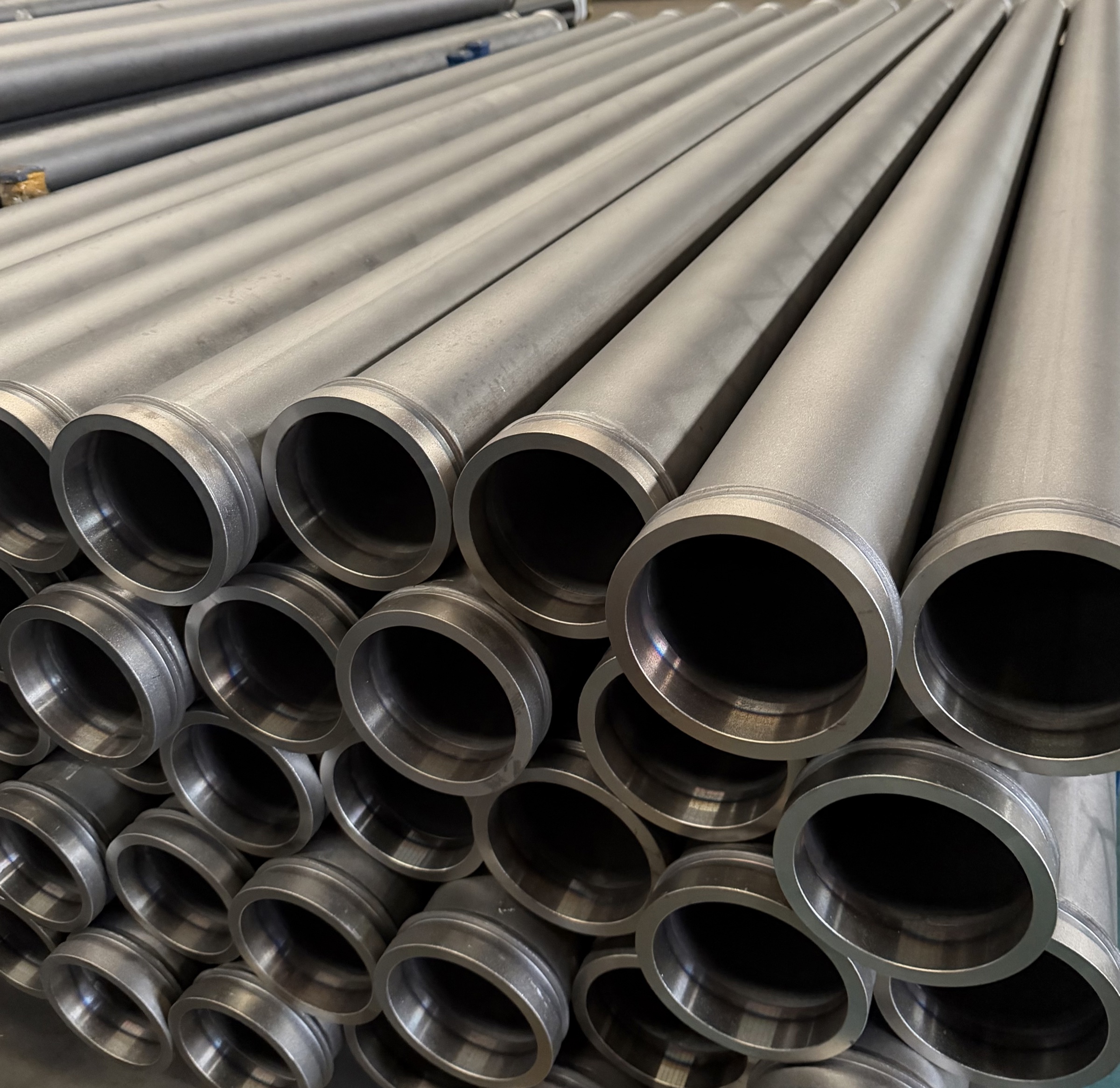
Overview
16Mn is a low-alloy high-strength structural steel. Its carbon content is approximately 0.1%–0.25%, and its main alloying elements are manganese, silicon, vanadium, niobium and titanium, with a total alloy content below 3%.
The steel is listed in strength grades of 300, 350, 400 and 450 MPa. Common grades are Q295, Q345, Q390, Q420 and Q460; in the designation "Q" stands for yield strength and the following number is the minimum yield strength, while the A, B, C or D suffix is the quality grade.
Grade A and Grade B are commonly referred to together as 16Mn — for example Q345B and Q355B. These pipes are supplied as unhardened steel: the wall itself is the wear surface, with no cast lining, ceramic layer or hardened bore. The range is available in several steel grades, including 16Mn and 55Mn, so the pipe can be matched to the working conditions of the duty.
Balanced strength and toughness
Low-alloy high-strength structural steel with a balanced strength and toughness combination.
Excellent formability
The grade forms readily, which keeps formed and fabricated parts straightforward to produce.
Easy machining and fabrication
Easy to machine and to fabricate.
Structure & shapes
16Mn pipes are plain unhardened steel pipes, so the pipe wall itself is the wear surface. Where a hardened inner wall is needed instead, 16Mn is also one of the base materials used for induction-hardened pipes — see Induction-Hardened Pipes under Related products.
Material: Low-alloy high-strength structural steel (16Mn; for example Q345B, Q355B)
Specifications
| Specification | Value |
|---|---|
| Material category | Low-alloy high-strength structural steel |
| Carbon content | Approximately 0.1%–0.25% |
| Main alloying elements | Manganese, silicon, vanadium, niobium, titanium |
| Total alloy content | < 3% |
| Strength grades | 300 / 350 / 400 / 450 MPa |
| Common grades | Q295 / Q345 / Q390 / Q420 / Q460 |
Working conditions
These are the duties this product is built for. Final selection depends on the measured conditions at your site — send them and our engineers will review the application rather than apply a single material rule.
- Mild abrasion in impact-prone duties; the unhardened steel body is ductile, and impact response is grade dependent
- Fine and coarse solids
- General slurry and bulk transfer
- Where the duty needs a hardened bore rather than plain steel, compare with induction-hardened pipes
Applications
Mining & Mineral Processing
Mining and mineral processing convey highly abrasive slurries and solids — mineral slurries, tailings, concentrates and backfill. Wear concentrates where flow changes direction and where solids travel at speed, so pipe, elbow and tee selection must follow the actual operating conditions rather than a single material rule.
Cement, Ceramics & Building Materials
Cement, ceramics and building-material handling moves both dry powders and granules and wet media — cement, clinker, slag and limestone powder on one side, and gypsum slurry, ceramic slurry and ceramic mortar on the other. The two states wear pipework differently and must be evaluated separately.
Power & Coal
Power and coal handling moves both dry media — pulverized coal and fly ash — and wet media such as ash slurry and coal slurry. Dry and wet conveying impose different wear and corrosion conditions, so each stream is evaluated on its own terms.
Steel & Metallurgy
Steel and metallurgy handling moves coarse, hard and highly abrasive solids — ore fines, coke fines, sinter, slag and metallurgical dust. Wear is driven by particle hardness and shape as much as by velocity, so liner selection follows the measured duty rather than a single material rule.
Downloads
Request a quote for 16Mn steel pipes
Tell us the medium, particle size, velocity, pressure and the dimensions you need — unknown values may be left open for our engineering review.
Drawings can be sent to info@wearresistantpipes.com.